

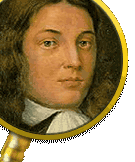







 Historical Markers In the Story
 Original Documents
Overview: The Vision of William Penn
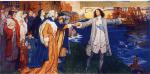

"Penn's Vision," by Violet Oakley, Governor's Reception Room...
Penn's tract of land consisted of 45,000 square miles of land, an area almost as large as England itself. King Charles named the new colony, "Penn's woods" in honor of the admiral. Penn called the capital city Philadelphia, meaning the "City of Brotherly Love," to reflect his desire that his colony serve as a haven for Quakers and other oppressed Christians seeking religious freedom.
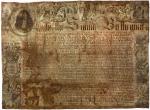
King Charles II charter to WIlliam Penn, 1681.
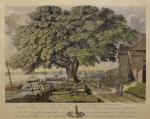
"The Great Treaty Elm of Shackamaxon (Now Kensington)" Aquatint with watercolor...
Penn did not offer settlers religious liberty in the modern sense of the term, for Pennsylvania's charter restricted the right to vote and to hold political office to Protestants. Pennsylvania denied those rights to Jews and Muslims, who did not believe in Christ as savior, and to Catholics, who were subservient to the Pope. For these groups, like other non-Protestants in the colony, religious toleration meant that they were free to worship and practice their faith in Pennsylvania.
Penn did not extend the protections of his charter to enslaved Africans and African-Americans either. Indeed, the proprietor kept at least three slaves at Pennsbury, his country estate above Philadelphia. The presence of race slavery in Penn's Holy Experiment would be a source of growing tension among Quakers and other Pennsylvania colonists for the next hundred years.
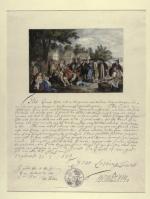
Penn's Letter
Penn's colony was also an experiment in a more democratic form of government than that which people had known in Europe. Pennsylvania's first constitution, the Frame of Government, promised settlers the enjoyment of such liberties as "a voice in government, the right of trial by jury and the liberty of conscience." To prevent corruption in government, Penn organized the government into three parts: a governor, a Provincial Council, and a bicameral legislature, elected by the people, in which the upper house drafted legislation and the lower house voted to approve or reject it.
The constitution gave tremendous independence to the Provincial Council and established the governor as a powerful executive. Penn's first Frame of Government, however, was only in existence for a year before he had to revise it. In 1683, Penn reluctantly granted a Second Frame of Government, better known as the Charter of Liberties, which granted more power to the Assembly, which had been pressuring him for greater authority. The struggle for a more democratic government in Pennsylvania would continue for decades.
Over the next twenty years, the Quakers who administered the government and the non-Quaker settlers became embroiled in heated disagreements over land distribution and rental fees, political patronage, the Quaker monopoly of commerce, and Penn's inability to govern effectively because of his fifteen-year absence from the colony. When Penn returned in 1699, he was besieged by demands to revise the constitution.
On October 28, 1701, Penn issued a new constitution, called the Charter of Privileges, to salvage his Holy Experiment. To appease the assembly and quarrelsome settlers, Penn gave a new unicameral legislature powers unknown elsewhere in the colonies. The charter reaffirmed the assembly's right to draft legislation, choose its speaker and other officers, and exercise all other powers and privileges of an assembly according to the freeborn subjects of England. It also reduced the council's role to an advisory capacity and eliminated the governor's power to suspend or dissolve the Assembly, although he could continue to veto legislation.
No other colonial assembly enjoyed so much power. No other governor was so clearly pitted against a legislative body. It was the exact opposite of what Penn had wanted when he established Pennsylvania two decades earlier. But the Charter of Privileges proved to be much less destructive of his Holy Experiment than he feared. The new constitution enhanced the principle of self-government, and preserved – on paper if not always in practice – Penn's unconditional commitment to religious toleration.
The Charter of Privileges served as Pennsylvania's constitution until overturned by the American Revolution some seventy-five years later. But Penn's legacy of toleration can still be seen in the First Amendment's protection of religious liberty as well as in the many reform organizations that still exist in the Commonwealth today.

